
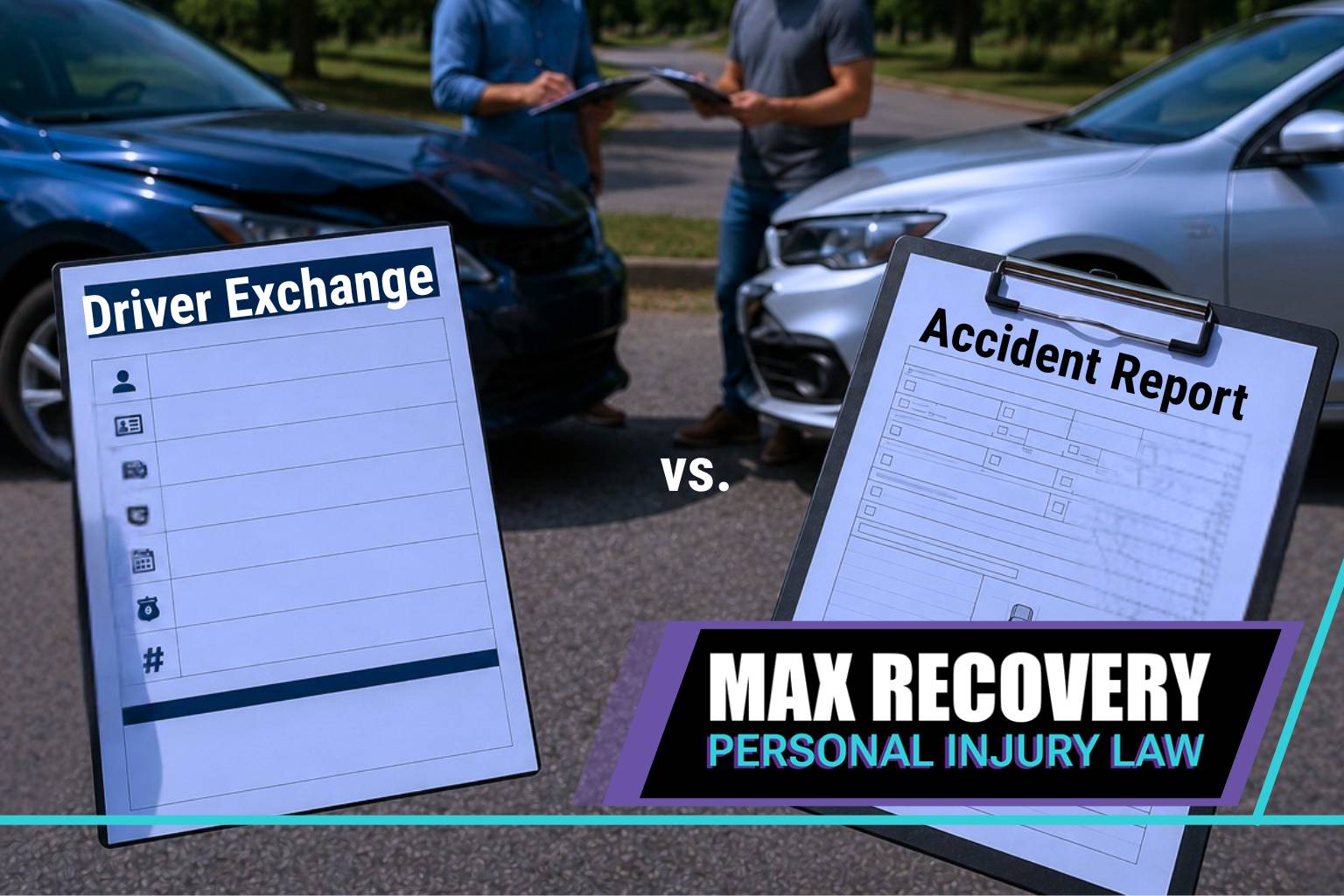
After a collision, a police officer may give you a driver exchange form before you leave the scene. Because it contains information about the drivers, vehicles, and insurance companies involved, you might assume it is the official accident report. However, a driver exchange and a North Carolina accident report are not the same document.
The driver exchange provides basic information that can help you begin an insurance claim. The official crash report, commonly called the DMV-349, contains a more detailed account of the collision and the investigating officer’s findings. That information may become important when an insurance company disputes fault or challenges an injury claim.
Understanding the difference between these documents can help you locate evidence, communicate with insurers, and protect your rights after a North Carolina car accident.
What Is a Driver Exchange Form?
A driver exchange form is generally a short document provided at or shortly after the accident scene. Its purpose is to give the people involved essential identifying and insurance information.
Depending on the circumstances, it may contain:
- The drivers’ names and contact information
- Driver’s license information
- Vehicle owners’ information
- License plate and vehicle identification numbers
- Insurance company and policy information
- The date and county of the collision
- The investigating officer’s name
- A local report or case number
The official NCDMV driver exchange form also explains how to request a certified crash report.
A driver exchange can help you identify the other driver’s insurer and begin reporting the collision. However, it usually does not contain the narrative, diagram, contributing circumstances, or other findings found in a North Carolina accident report.
What Is a North Carolina Accident Report?
A North Carolina accident report is the comprehensive document prepared after law enforcement investigates a reportable collision. The standardized form used by law enforcement agencies throughout the state is known as the DMV-349 Motor Vehicle Crash Report.
Although drivers often call it an accident report or police report, “crash report” is the terminology used by NCDMV. In this context, the terms generally refer to the same official document.
The DMV-349 may include:
- Driver, passenger, and vehicle information
- The location, date, and time of the crash
- Weather, lighting, and road conditions
- Traffic controls and vehicle movements
- Reported injuries and emergency transportation
- Witness and occupant information
- Apparent contributing circumstances
- An officer’s diagram and narrative
- Citations or suspected traffic violations
This information makes the report useful when investigating how a collision happened. Nevertheless, it should be considered alongside photographs, videos, witness accounts, medical records, and other available evidence.
The Main Difference Between the Documents
The primary difference is the amount and purpose of the information each document provides.
A driver exchange is an information-sharing tool. It gives the parties enough information to contact insurers and identify the corresponding police case. It may be available before the officer completes the investigation.
A North Carolina accident report, by comparison, documents the investigated crash in greater detail. It may explain the vehicles’ movements, identify contributing circumstances, include a diagram, and summarize information obtained during the investigation.
In simple terms, the driver exchange helps you start the claim. The accident report helps explain the collision.
Why Did the Officer Give Me Only a Driver Exchange?
Receiving only a driver exchange at the scene does not mean the officer failed to prepare a report. Officers frequently need additional time to complete and submit the DMV-349.
The officer may need to interview witnesses, confirm insurance information, prepare a diagram, or speak with someone transported for medical care. The full report may therefore be unavailable immediately.
The case number on the driver exchange can help you locate the completed North Carolina accident report later. Keep the exchange in a safe place and consider photographing it in case the original is lost.
When Is a Crash Report Required?
North Carolina defines a reportable crash as one involving a motor vehicle that causes a death or injury, at least $1,000 in total property damage, or damage of any amount to a vehicle seized under the applicable statute.
A driver involved in a reportable crash must immediately notify the appropriate law enforcement agency. Within a municipality, this will ordinarily be the local police department. Outside a city or town, it may be the State Highway Patrol, sheriff’s office, or another qualified law enforcement agency.
Under North Carolina General Statute § 20-166.1, the agency must investigate a reportable crash, and the investigating officer must prepare a written report. The current definition of a reportable crash appears in North Carolina General Statute § 20-4.01.
Because vehicle damage can exceed $1,000 even when it initially appears minor, calling law enforcement is often prudent. It is particularly important when someone may be injured, a driver leaves the scene, impairment is suspected, or the parties disagree about what happened.
How Do You Obtain a North Carolina Accident Report?
The investigating agency may provide instructions for obtaining the completed report. You may also request one through NCDMV.
NCDMV explains that a person involved in the crash may request a redacted copy in person or by mail using Form TR-67A. Access to unredacted reports is restricted because they can contain private information about several people. Qualified attorneys, insurers, investigators, and other organizations may obtain unredacted reports when they have a legally permissible purpose.
Current procedures, identification requirements, processing information, and fees are available on the official NCDMV crash report request page.
You may need information from the driver exchange, including the accident date, driver’s name, investigating agency, or report number. If the report is unavailable, ask the agency when it expects the document to be completed.
Why the Accident Report Matters to an Insurance Claim
A North Carolina accident report provides insurers with an organized account of the collision. Adjusters may examine its diagram, narrative, vehicle movements, conditions, and apparent contributing circumstances when evaluating liability.
The report can help confirm:
- The identities of the drivers and vehicle owners
- The location and time of the crash
- Whether witnesses were identified
- Whether injuries were reported
- Whether emergency transportation was required
- How the vehicles were positioned or damaged
The report does not replace a complete investigation. Adjusters may also review photographs, statements, repair estimates, medical documentation, electronic data, and available video.
If a report is incomplete or contains an unfavorable description, additional evidence may be needed to present a more complete account of the collision.
Does the N.C. Accident Report Determine Fault?
Not by itself.
The officer may record contributing circumstances, issue citations, prepare a diagram, or describe the collision in a narrative. These findings can influence an insurance investigation, but they do not automatically create a final legal determination of fault.
Insurance companies conduct their own investigations. If a liability dispute cannot be resolved, a court may ultimately determine responsibility based on the admissible evidence and applicable law.
This distinction is especially important because North Carolina follows the contributory negligence doctrine. An insurer may argue that an injured person contributed to the collision and cannot recover compensation. A North Carolina accident report may be important to that dispute, but it is rarely the only relevant evidence.
What If Either Document Contains an Error?
Review both documents carefully. Names, policy numbers, license plates, vehicle details, and contact information may occasionally be entered incorrectly.
If you identify an objective error, contact the investigating agency and provide documentation showing the correct information. You should also notify your insurer if the mistake could affect its ability to identify a vehicle, driver, or insurance policy.
There is a difference between a factual mistake, such as an incorrect vehicle model, and disagreement with the officer’s conclusions. An agency may correct a verifiable error but decline to change an investigative opinion simply because a driver disagrees with it.
Even if the agency does not revise the North Carolina accident report, photographs, videos, witness statements, and other evidence may still be presented during the claim.
Evidence to Preserve After the Crash
Neither document captures everything that may matter after a serious accident. Evidence can disappear quickly, particularly surveillance and traffic-camera recordings.
When possible, preserve:
- Accident-scene and vehicle photographs
- Dashcam or surveillance recordings
- Witness contact information
- Medical records and bills
- Repair estimates and towing records
- Pay records documenting lost income
- Insurance correspondence
- Receipts for accident-related expenses
Seek prompt medical care if you are injured or develop symptoms after leaving the scene. The driver exchange may identify the parties, while the North Carolina accident report documents the investigation. Medical records establish your injuries, diagnosis, treatment, and recovery.
Should You Give an Insurance Company a Recorded Statement?
You should report the collision to your own insurer and cooperate with reasonable policy requirements. However, use caution if the other driver’s insurance company requests a recorded statement.
Statements about speed, visibility, distractions, injuries, or vehicle movements may become part of a liability dispute. Do not guess when you do not know an answer, and avoid minimizing symptoms before their severity is clear.
If you were injured or fault is disputed, consider speaking with an attorney before providing a detailed recorded statement to the opposing insurer.
How MAX Recovery Can Help
An incomplete or inaccurate report can create problems when an insurer is looking for a reason to deny or reduce a claim. The attorneys at MAX Recovery can obtain and review the available documents, investigate discrepancies, preserve evidence, communicate with insurers, and evaluate how North Carolina law applies.
Our team can also examine evidence that may not appear in the North Carolina accident report, including surveillance footage, witness testimony, medical documentation, and accident-scene photographs.
If you were injured in a collision, contact MAX Recovery for a free consultation. We can explain your driver exchange, help you obtain the official report, and discuss your options for pursuing compensation.
Frequently Asked Questions
Is a driver exchange the same as a police report?
No. A driver exchange provides basic driver, vehicle, insurance, officer, and case information. A North Carolina accident report is the more detailed DMV-349 prepared following the investigation.
Can I start an insurance claim with only the driver exchange?
Usually, yes. The exchange may provide enough information to identify the parties and insurers. The company may later request the official report and additional evidence.
How long does it take to receive the accident report?
Timing varies by agency and the complexity of the collision. Ask the investigating agency about its expected completion time and request procedure.
Does the police report prove who caused the accident?
No. It may contain influential evidence, but insurers conduct separate investigations. A court may ultimately resolve disputed liability.
Can an attorney obtain the complete report?
A qualified attorney representing someone involved in the crash may request an unredacted report for a permissible legal purpose, subject to privacy laws and NCDMV procedures.

 AI Review Summary


